17.01.2020

Mit additiver Fertigung zu mehr Produktivität - Glockenwerkzeug zur Außenbearbeitung von MAPAL
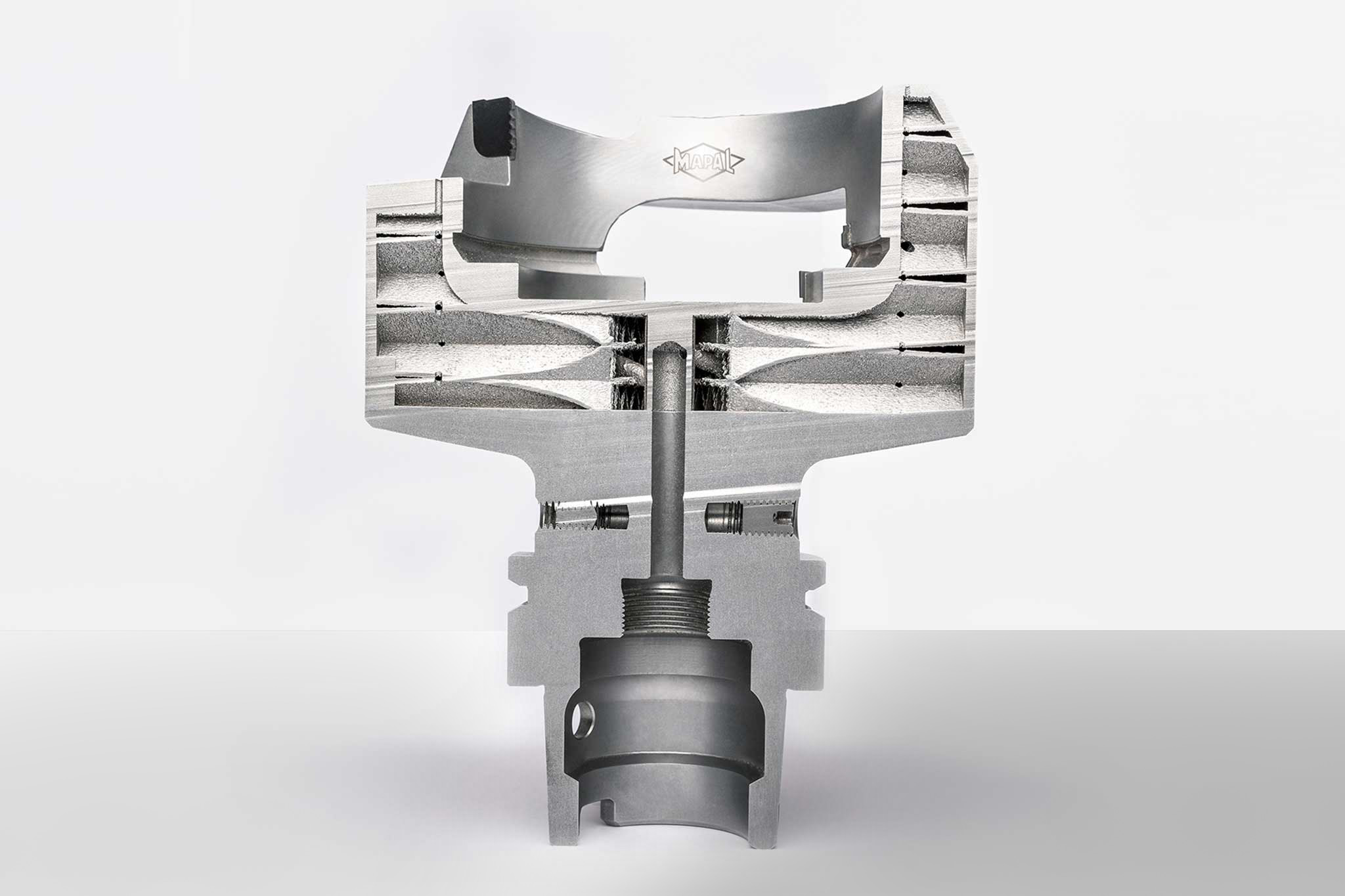
Ein Schnitt des Glockenwerkzeugs. Im Inneren die Wabenstruktur des Werkzeugbereich, die additiv gefertigt ist.
  • Ein Schnitt des Glockenwerkzeugs. Im Inneren die Wabenstruktur des Werkzeugbereich, die additiv gefertigt ist.

Dank geringerem Gewicht zu deutlich höheren Schnittdaten

Reduzieren Werkzeughersteller bei PKD-Werkzeugen das Gewicht, können Zerspaner in der Regel mit deutlich höheren Schnittdaten arbeiten. Die Möglichkeit, das Gewicht zu optimieren ist neben der konstruktiven Freiheit einer der entscheidenden Vorteile, die der 3D-Druck bietet. Durch speziell entwickelte Strukturen im Inneren des Werkzeugs, die konventionell nicht zu fertigen sind, können Werkzeughersteller das Gewicht erheblich reduzieren.

New bell tool with low weight, long tool life and best cutting data

An example of how MAPAL uses this advantage of 3D printing in practice is the new bell tools with brazed PCD inserts. Bell tools are used for the external machining of hose connections, among other applications. These connections, for example on turbochargers, must satisfy complex contour requirements. Manufacturing must be correspondingly precise. Existing processes are also subject to continuous improvement so that manufacturing is cost-effective and reliable in series production.

MAPAL has therefore optimised the existing, conventionally manufactured bell tool. Using the selective laser melting process, the inside of the tool has been modified – instead of solid material there is now a specially designed honeycomb structure. As a consequence, the tool is 30 percent lighter and the tool life is increased by approx. 40 percent due to the damping effect. It is therefore possible to machine faster; the machining quality remains at the same high level. In total the machining time has been reduced by 50 percent. 

A cut of the bell tool. Inside, the honeycomb structure of the tool area, which is 3D printed.
The honeycomb structure inside can be realised thanks to additive manufacturing. 

The manufacturing process of the bell tool

The new bell tool is of hybrid design. Using selective laser melting, the new tool geometry is printed on a highly precise tool body with a HSK-63 connection. The additively manufactured part is subsequently machined conventionally. Then the PCD inserts are brazed in place and cut to shape using a laser. 

Kathrin Rehor, PR Project Manager at MAPAL

Contact

Kathrin Rehor Public Relations Kathrin.Rehor@mapal.com Phone: +49 7361 585 3342


Further articles from the section Technology